
สรุปบทความ
If you've ever wondered what a proxy server is — or why so many businesses and developers rely on them — you're in the right place. In this guide, we'll break down everything you need to know about pr
สารบัญ
If you've ever wondered what a proxy server is — or why so many businesses and developers rely on them — you're in the right place. In this guide, we'll break down everything you need to know about proxies: what they are, how they work, the different types available, and when you should use one.
What Is a Proxy Server?
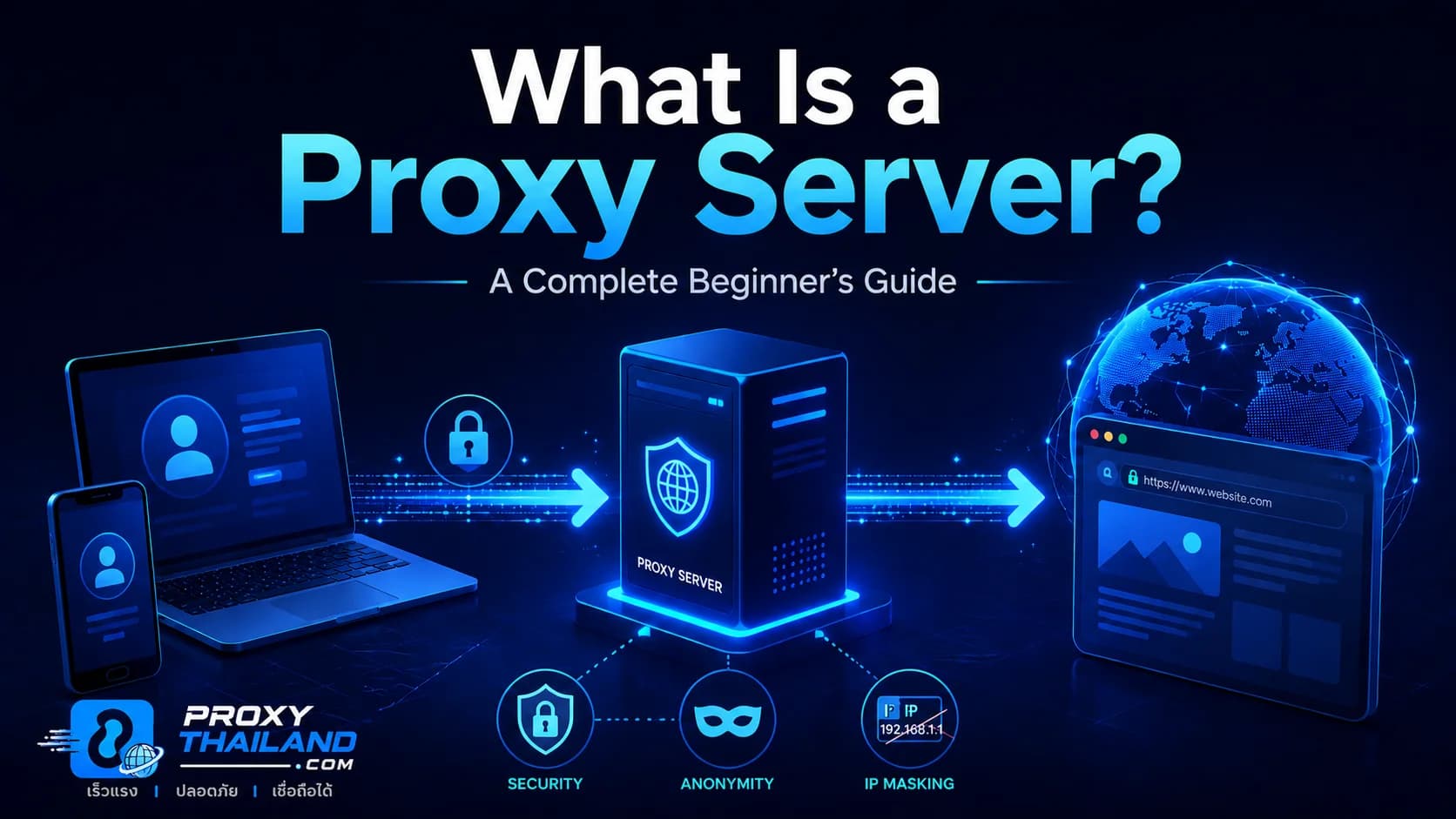
A proxy server is an intermediary server that sits between your device (client) and the website or online service you want to access (destination server). When you use a proxy, your internet requests go through the proxy server first, which then forwards those requests to the target website using its own IP address.
In simple terms: instead of connecting directly to a website, you connect through a middleman. The website sees the proxy's IP address, not yours.
A Simple Analogy
Imagine you want to send a letter to someone, but you don't want them to know your address. So you give the letter to a trusted friend, who sends it on your behalf using their return address. That's essentially what a proxy does — it acts as your representative on the internet.
How Does a Proxy Server Work?
Here's what happens step-by-step when you use a proxy:
You send a request — You type a URL or click a link. Instead of going directly to the website, your request goes to the proxy server.
The proxy forwards it — The proxy server receives your request and sends it to the target website, using its own IP address.
The website responds — The target website sends the response back to the proxy server.
The proxy delivers it to you — The proxy forwards the response to your device.
The whole process typically happens in milliseconds, so you barely notice any difference in your browsing experience.
Why Use a Proxy Server?
1. Hide Your IP Address and Stay Anonymous
The most common reason to use a proxy is anonymity. By masking your real IP address, you prevent websites, advertisers, and other third parties from tracking your location or identity online.
2. Bypass Geo-Restrictions
Some websites and online services restrict access based on geographic location. A proxy lets you appear to be browsing from a different country, giving you access to geo-blocked content.
3. Improve Security on Public Networks
Businesses use proxy servers to add an extra layer of protection between their internal networks and the open internet, reducing exposure to cyber threats.
4. Web Scraping and Data Collection
Developers and data analysts use proxies to collect large amounts of data from websites without getting blocked. A rotating proxy automatically switches IP addresses, making it difficult for websites to detect and block automated requests.
5. Content Filtering for Organizations
Schools and companies use proxy servers to block access to certain websites or categories of content, keeping employees or students focused.
6. Load Balancing
Large organizations use proxies to distribute incoming web traffic across multiple servers, preventing any one server from becoming overwhelmed.
Types of Proxy Servers
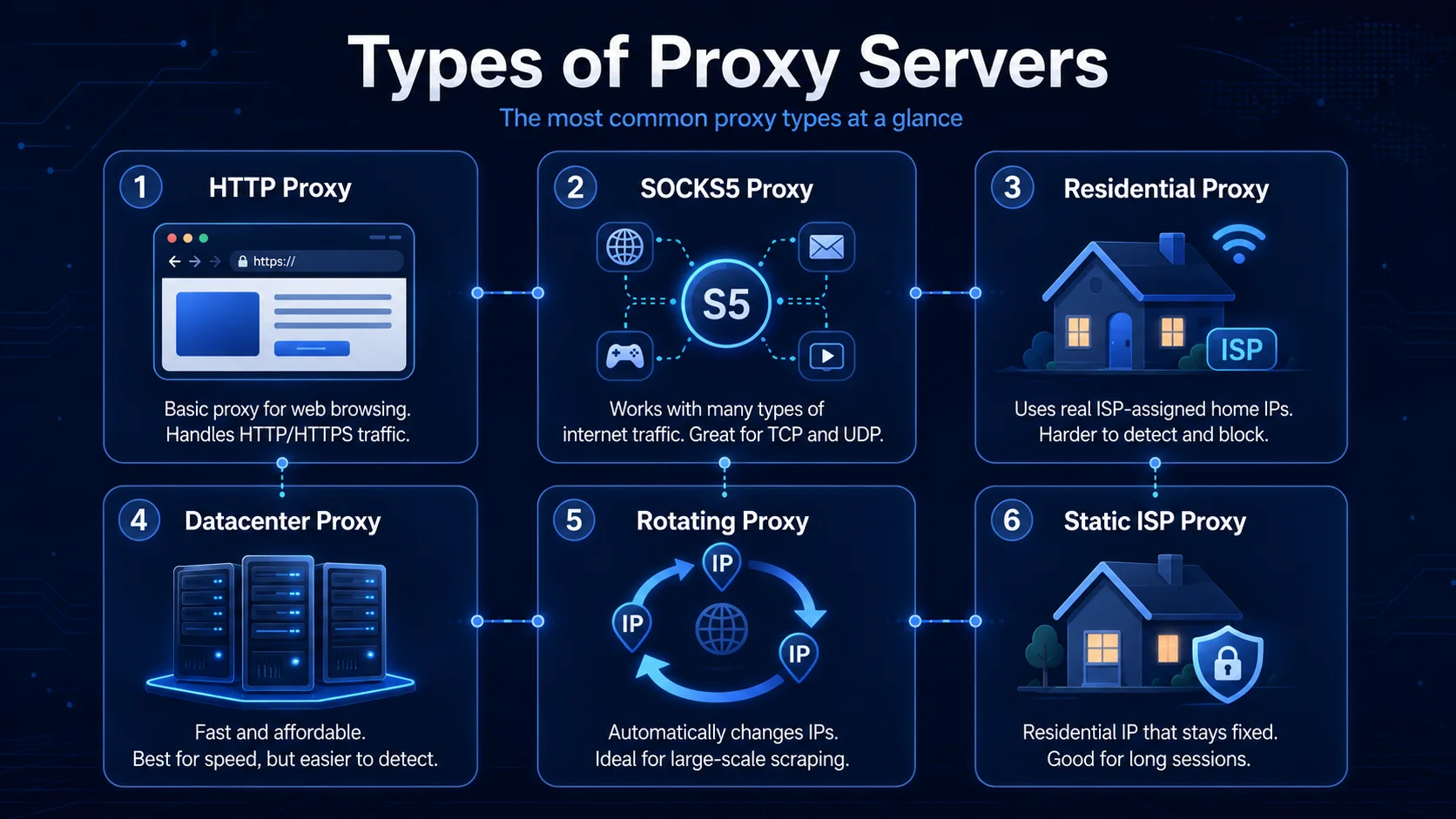
Not all proxies are the same. Here's a breakdown of the most common types:
HTTP Proxy
The most basic type of proxy. It's designed for web browsing and handles HTTP and HTTPS traffic. Most browser-level proxy settings use this type.
SOCKS5 Proxy
A more versatile proxy that works with any kind of internet traffic — not just web browsing. SOCKS5 supports TCP and UDP connections, making it ideal for things like torrenting, gaming, and email clients.
Residential Proxy
Uses IP addresses assigned to real homes and devices by internet service providers (ISPs). Because these IPs look like genuine user connections, residential proxies are much harder for websites to detect and block. They're the go-to choice for web scraping and social media management.
Datacenter Proxy
IP addresses that come from data centers rather than real households. They're faster and cheaper than residential proxies but are more easily identified as proxies by sophisticated websites.
Rotating Proxy
A proxy that automatically rotates through a pool of IP addresses with each new request or at set intervals. Rotating proxies are essential for high-volume web scraping, as they prevent IP-based rate limiting and bans.
Static ISP Proxy
A residential IP that stays fixed (doesn't rotate). It combines the trustworthiness of a residential IP with the consistency of a datacenter proxy — useful when you need the same IP for extended periods.
Proxy vs. VPN: What's the Difference?
People often confuse proxies with VPNs. While they both hide your IP address, there are key differences:
Encryption: Proxies usually don't encrypt traffic; VPNs always do.
Coverage: Proxies work at the app level; VPNs cover your entire device.
Speed: Proxies are faster because there's no encryption overhead.
Cost: Proxies are more affordable, especially when you need many IPs.
Best for: Use proxies for business automation and scraping; VPNs for personal privacy.
Who Should Use a Proxy?
E-commerce businesses monitoring competitor prices on Shopee, Lazada, or Amazon
Digital marketers tracking SEO rankings across different locations
Developers testing how their apps look and behave from different countries
Data scientists collecting large datasets from the web
Social media managers running multiple accounts without risk of bans
Brands verifying that their ads are displaying correctly in different markets
Is Using a Proxy Legal?
Yes, using a proxy is completely legal in most countries, including Thailand. Proxy servers are legitimate tools used by businesses worldwide for data collection, ad verification, market research, and security. However, using proxies to conduct illegal activities — such as hacking, fraud, or copyright infringement — is of course illegal, regardless of the tool used.
Conclusion
A proxy server is a powerful, flexible tool that can help you browse anonymously, bypass restrictions, collect data at scale, and power your business intelligence efforts. Whether you're a developer, digital marketer, or business owner, the right proxy can give you a significant competitive edge.
Ready to get started? ProxyThailand offers residential, datacenter, and rotating proxy plans tailored for businesses of all sizes — with English and Thai support available around the clock.
แท็กที่เกี่ยวข้อง
เขียนโดย ทีมงาน PROXYTHAILAND
ผู้เชี่ยวชาญด้าน Proxy และบริการเครือข่าย รองรับ IPv4/IPv6 HTTP/HTTPS/SOCKS5 กว่า 11 ประเทศทั่วโลก